


The Horrific True Story Behind “The Bombing of Pan Am 103”
The Horrific True Story Behind “The Bombing of Pan Am 103”

Keith LangstonThu, July 30, 2026 at 10:00 AM UTC
0
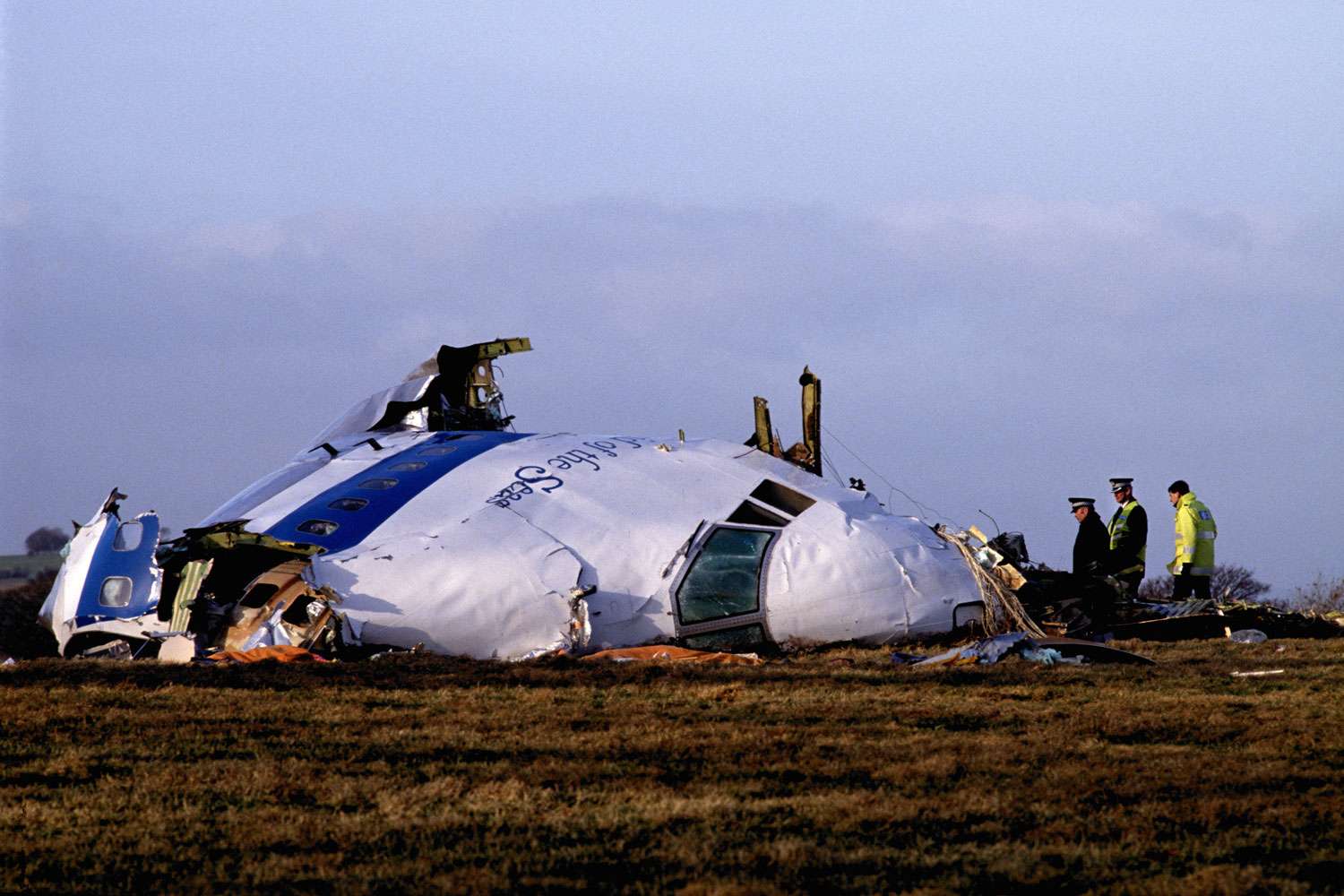
The wreckage of the Pan-Am 747 plane which was blown up en route to JFK airport by Libyan terrorists.Credit: Tom Stoddart/Getty -
The Bombing of Pan Am 103 explores the 1988 tragedy that killed 270 people and devastated the town of Lockerbie in Scotland
The series highlights the human impact of the disaster and the decades-long investigation into the terrorist attack
In real life, Abdel Basset Ali al-Megrahi was convicted of 270 counts of murder
The Bombing of Pan Am 103 tells the real-life tragedy of Pan Am flight 103.
The BBC and Netflix miniseries is based on the true story of Pan Am Flight 103, when a Boeing 747 flying from London to New York City on Dec. 21, 1988, suddenly exploded less than an hour after takeoff over the small Scottish town of Lockerbie. All 259 passengers were killed, as well as 11 civilians on the ground who were hit by falling debris.
The Lockerbie crash remains the largest crime scene in history, per the FBI, as bodies, pieces of the plane and other debris were scattered throughout an area of 845 square miles. The disaster changed air travel forever and launched a decades-long investigation that’s ongoing.
The series has a large ensemble cast, including Emmy winner Merritt Wever, Tony Curran and Patrick J. Adams, and tells the story from numerous perspectives, including the CIA, police officers, passengers’ families and locals of the small Scottish town where the plane crashed.
“Our series focuses not only on what turned out to be a very long and complicated investigation with a lot of different law enforcement agencies working together,” Adams told the BBC in May 2025. “But also the human impact and the stories of some of the victims and their families as they try to make sense of this horrific event.”
Here’s everything to know about the true story behind the Netflix miniseries The Bombing of Pan Am 103.
What was Pan Am Flight 103?
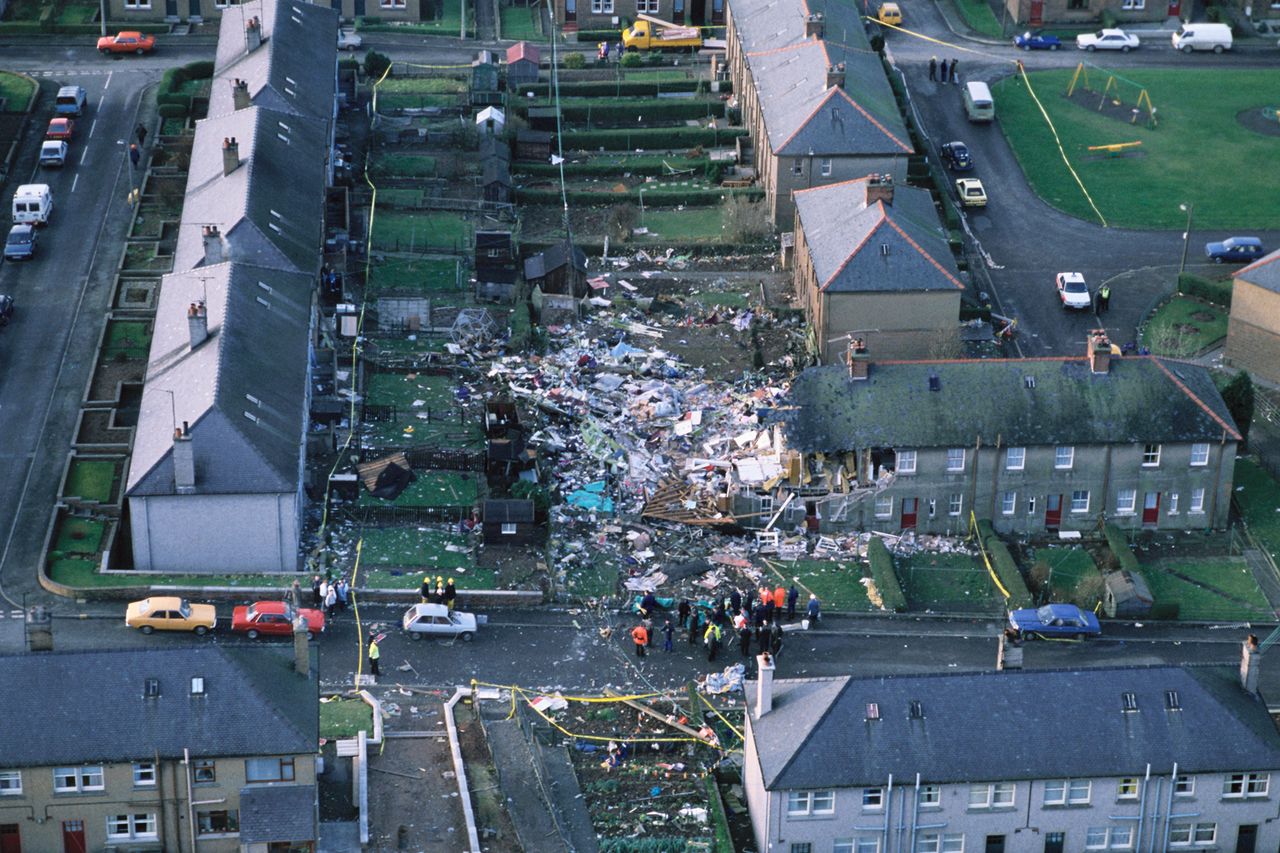
Aircraft debris and destroyed houses in the village of Lockerbie are seen from the air following the midair bombing of Pan Am flight 103.Credit: Bryn Colton/Getty
Pan American Flight 103 was a passenger flight operated on a Boeing 747 named Clipper Maid of the Seas. The flight originated in Frankfurt, Germany, with stops in London and N.Y.C. before reaching its final destination in Detroit. The flight began on a Boeing 727 in Frankfurt before transferring passengers and luggage to the 747 during its London stop for the transatlantic leg of the journey.
The flight had a crew of 16 with 243 passengers aboard, including United Nations official Bernt Carlsson, musician Paul Jeffreys and 35 Syracuse University students who were returning home for Christmas after a study abroad program.
Less than an hour after taking off from London, the plane exploded at around 30,000 feet above the small Scottish town of Lockerbie, with large chunks of the plane raining down over the community before the main section crashed into a residential street. All 259 aboard were killed, along with 11 locals on the ground.
“Bits of the jet had just fallen in the main street,” Sydney Morning Herald journalist Richard Glover told Australia’s The Newsreader in February 2025 about what it was like to cover the incident. “There was a smoldering jet engine just sort of sitting there.”
Lockerbie residents Hugh and Margaret Connell discovered Chase Manhattan Bank executive Frank Ciulla’s body near their home. The farmers watched over his remains for 34 hours until authorities recovered them.
“We developed quite a love for ‘our boy,’ as we called him,” Hugh told the CNN series Lockerbie: The Bombing of Pan Am 103, which premiered in February 2025.
Ciulla’s family didn’t learn about the Connells’ involvement until 1992, when they traveled to Scotland in search of answers.
“They took it as their responsibility to protect him, and to make sure that they were checking on him through the night,” Ciulla’s daughter Michelle told the docuseries. “I can’t even tell you the relief that was for all of us.”
What caused Pan Am 103 to explode?
Pan Am Flight 103 exploded shortly after reaching cruising altitude. A bomb had been hidden inside a radio that was placed in a piece of luggage in the cargo hold, per the FBI. At around 7:03 p.m., the bomb detonated, creating a series of catastrophic damages that caused the 747 to break apart.
The forward part of the plane broke off and plummeted to the ground, while the rest of the jet continued to break apart as it flew forward with its engines still running, according to The Guardian. But without a nose to keep it steady, the jet began to slope downward and eventually free-fall.
Because the plane depressurized at 30,000 feet, all passengers and crew likely lost consciousness before the crash. The plane fell at half the speed of sound, with some of the engines still turning as it hit the ground, causing a massive explosion that destroyed entire areas of Lockerbie, according to the outlet.
Who bombed Pan Am 103?
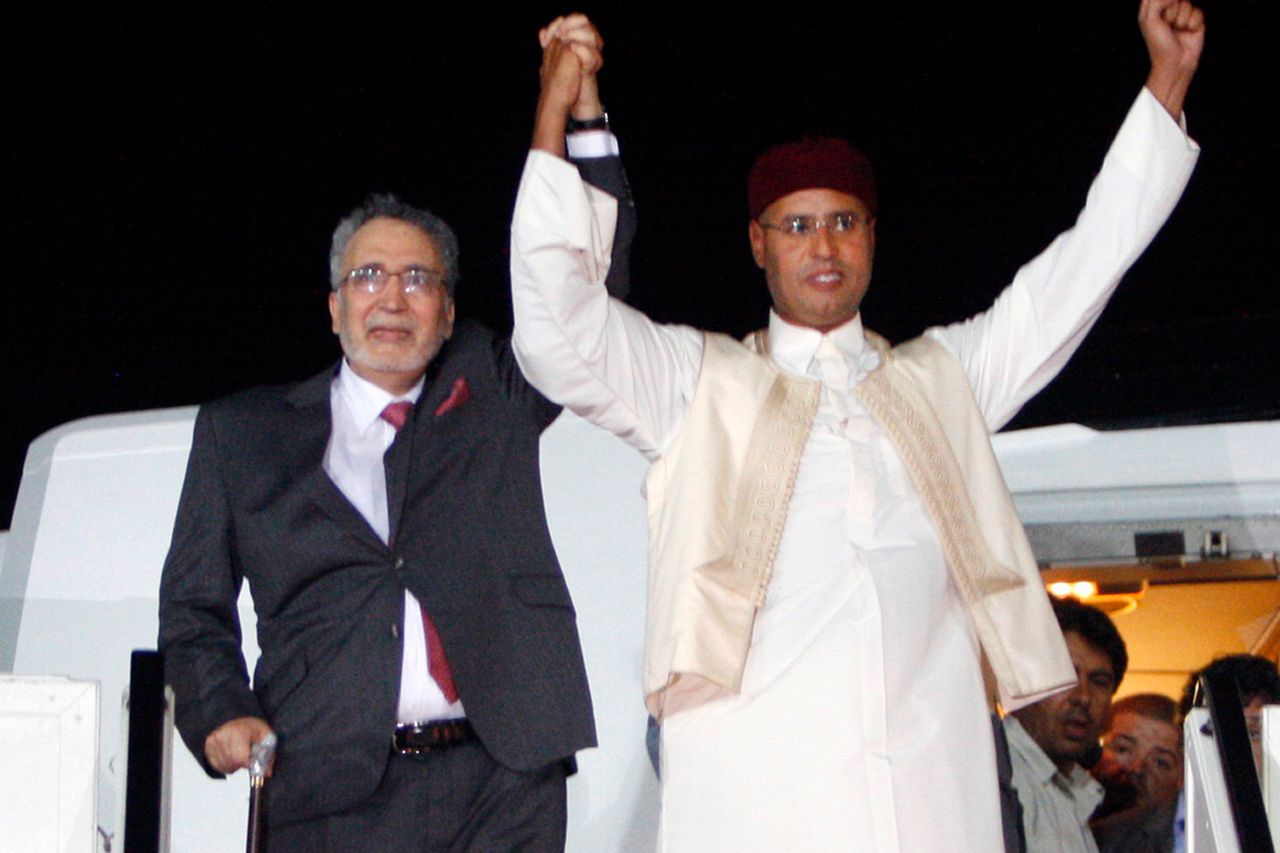
Abdel Baset al-Megrahi (L) who was found guilty of the 1988 Lockerbie bombing and son of the Libyan leader Seif al-Islam Gadhafi (R) in Tripoli, Libya.Credit: AP Photo
The investigation into Pan Am 103 became a sprawling, multinational effort between the U.S., the U.K. and Germany, who examined thousands of pieces of evidence and, per the FBI, conducted over 10,000 interviews across 16 countries.
But one piece of evidence changed everything. In 1989, a scorched piece of shirt was discovered among the wreckage that had a small fragment of a circuit board fused into the fabric. An electronics forensics expert observed that the circuit board was almost identical to one Libya had used in a prior terrorist bombing, according to the CIA.
The shirt piece — along with a few other scraps of fabric from one suitcase in particular — showed traces of the chemicals RDX and PETN, which are commonly left behind after Semtex explosions, per The Guardian. One of the pieces that tested positive still had its tag, which read “Malta Trading Company.”
Advertisement
Per CNN, a group traveled to the store in Malta, where the shop owner, Tony Gauci, reported that a few weeks prior to the flight, a Libyan customer had come in and bought a random assortment of clothing without checking the sizes or prices of anything he bought.
Investigators then discovered that two Libyan agents had previously been arrested in Senegal earlier in 1988 with a device that looked similar to the one used in the Pan Am 103 bombing.
In 1991, a star witness named Abdel Madshid Jiacha — a former Libyan secret agent who had formerly worked at Libyan Arab Airlines at the Malta airport — implicated Libyan intelligence agents Abdel Basset Ali al-Megrahi and Lamen Khalifa Fhimah in the attack, per The Guardian. Jiacha claimed he’d seen the two loading the suitcase containing the bomb into the plane in Malta, which was then bound for the Frankfurt airport.
Per ABC News, Megrahi had traveled to Malta using a fake passport issued by the Libyan government. Records then suggested that an item of luggage had been loaded onto the plane from Malta, which was then bound for Frankfurt. Gauci later identified Megrahi as the customer who had bought the random assortment of clothing.
Jiacha has alleged that the bombing was revenge for the U.S. bombings of Tripoli and Benghazi in 1986, which were ordered by President Ronald Reagan.
The U.S. air strikes were retaliationfor Libyan agents’ bombing of a German nightclub that killed three people, an effort to kill Libya’s ruler Muammar Gaddafi and aimed to be a deterrent from committing further terrorist attacks. Gaddafi lived through the bombings, but claimed his adopted infant daughter, Hana, was killed in the attack, per Politico.
In 2003, Libya formally took responsibility for bombing Pan Am 103. “Libya as a sovereign state accepts responsibilities for the actions of its officials,” their ambassador said in a statement (via The Washington Post). The country agreed to paynearly $3 billion to the victims’ families, per the FBI.
What happened to the Pan Am 103 terrorists?
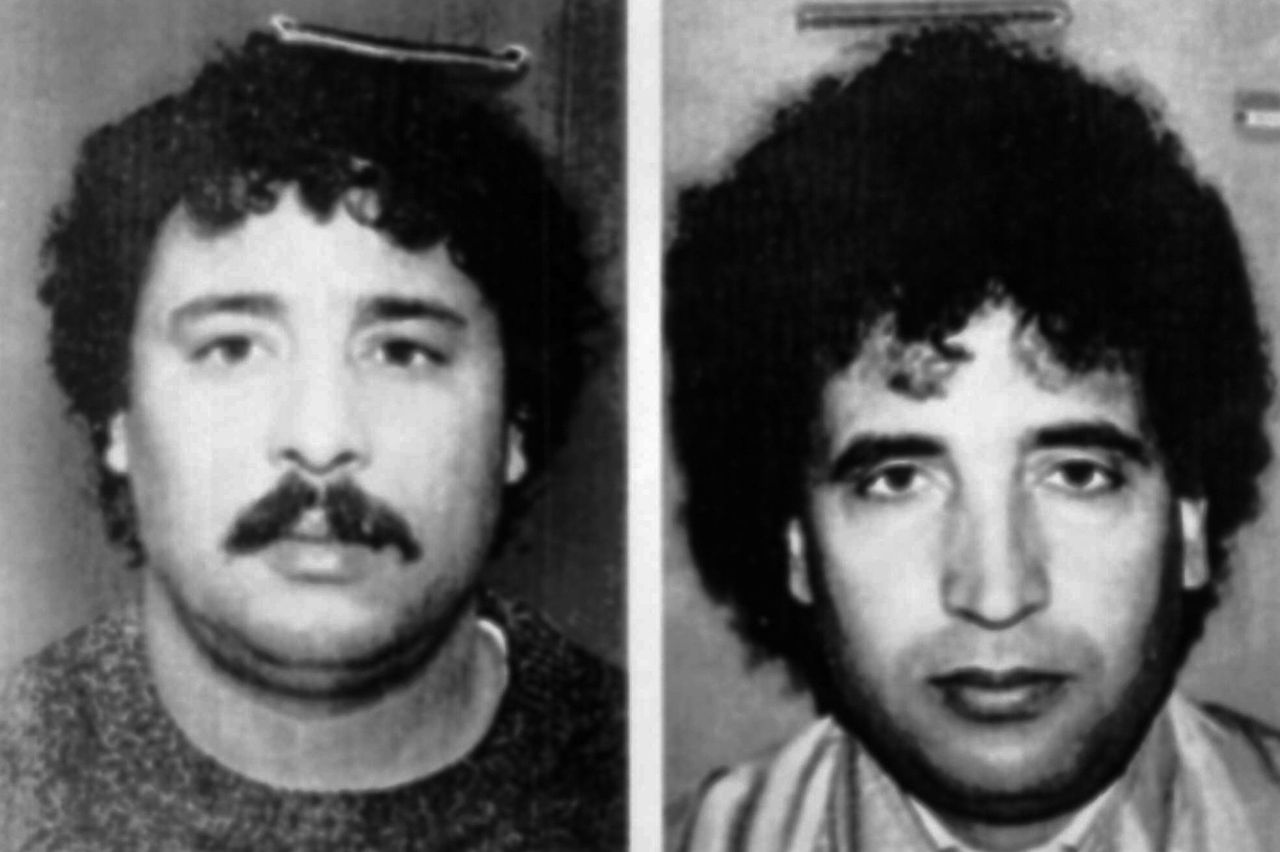
Lamen Khalifa Fhimah (L) and Abdel Basset Ali al-Megrahi (R).Credit: AP Photo
Fhimah and Megrahi went on trial in May 2000. In January 2001, Fhimah was acquitted due to a lack of evidence.
Meanwhile, Megrahi was found guilty of 270 counts of murder and sentenced to life in prison in Scotland, per the FBI. The decision was subsequently appealed, and that appeal was denied in 2002.
However, the Scottish Criminal Cases Review Commission later ruled in June 2007 that there were several areas in which “a miscarriage of justice may have occurred,” per The New York Times, including Gauci’s testimony. Megrahi’s second appeal was later dropped as he was released on compassionate grounds due to a terminal prostate cancer diagnosis in 2009, according to NPR.
Victims’ families were outraged at the news, believing that freeing Megrahi was about politics and not justice.
“I think it’s unconscionable that he would have the audacity to apply on compassionate grounds to be released, and that they would actually consider it.” Victoria Cummock, whose husband, John, died in the bombing, told CNN in 2009. “Nevertheless, not only did they consider it, they granted it.”
After three years, Megrahi died in 2012 in Tripoli.
In December 2020, a third Libyan official was implicated in the bombing of Pan Am 103, per CBS News. Abu Agila Mas’ud Kheir Al-Marimi was charged with destruction of an aircraft resulting in death and destruction of a vehicle of interstate commerce by means of an explosive resulting in death.
Mas’ud confessed to building the bomb used in the attack, but later retracted the claim and alleged that he was forced to confess, according to the BBC. He is still awaiting trial.
What changed following the bombing of Pan Am 103?
The bombing of Pan Am 103 altered air travel forever and led the U.S. to enact more rigorous air safety measures. The Aviation Security Act of 1990 required new federal training for airport workers and directed the Federal Aviation Administration (FAA) to research counter-terrorism methods.
Additionally, the bombing shepherded the establishment of the Office for Victim Assistance at the FBI. Robert Mueller — who was the assistant attorney general at the Department of Justice during the bombing — requested its creation shortly after he became FBI director in 2001.
“He said, ‘I want a professional victim assistance program. I want you to be able to do for victims, particularly terrorism victims, what you did with Pan Am 103,’ ” Kathryn Turman, assistant director, FBI Victim Services Division, recalled to the organization in December 2018. “The approach was to make sure that families have information, make sure they have support, make sure we take their needs seriously and help them get through one of the most horrible things that can happen to somebody.”
Today, the FBI’s Victim Services Division cleans and returns personal effects to victims of crimes, just as the Scottish police did after the bombing of Pan Am 103.
on People
Source: “AOL Entertainment”
